Our Curriculum
At Spanish Mastery with Miss María, our curriculum is designed to help students become confident, independent Spanish speakers through meaningful, engaging, and proficiency-based instruction. Rather than focusing on memorization alone, students learn to communicate naturally while developing the skills needed to use Spanish in real-world situations.
Our curriculum is aligned with internationally recognized language proficiency standards and research-based instructional practices. This curriculum serves as the foundation for all Spanish Mastery programs and is thoughtfully adapted to meet the unique needs, proficiency level, and learning goals of every student.
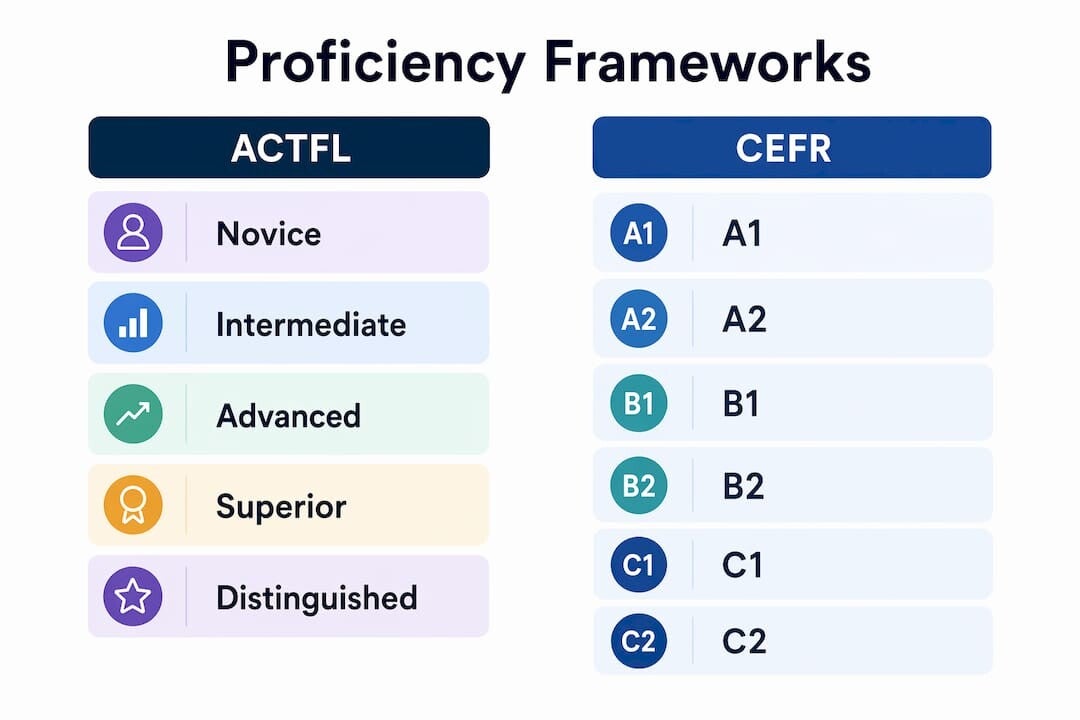
Proficiency Standards
Our Spanish Proficiency Program follows the Common European Framework of Reference for Languages (CEFR) proficiency levels A1–C2 and is informed by the American Council on the Teaching of Foreign Languages (ACTFL) Proficiency Guidelines. Together, these internationally recognized frameworks provide a structured pathway for developing measurable language proficiency while emphasizing what students can do with the language in authentic, real-world contexts.

Teaching Methodology
Our curriculum incorporates research-based instructional practices that promote meaningful language acquisition, student engagement, and long-term success.
-
Communicative Language Teaching (CLT) – Students learn Spanish by actively using the language in authentic, real-world communication rather than through memorization alone.
-
Project-Based Learning (PBL) – Students apply their language skills through meaningful projects that foster creativity, collaboration, critical thinking, and real-world application.
-
Total Physical Response (TPR) – Especially for young learners, language is reinforced through movement, gestures, and physical actions that strengthen comprehension, engagement, and long-term retention.
-
Foreign Language in the Elementary School (FLES) – For elementary students (Grades 3–5), instruction incorporates developmentally appropriate practices such as games, storytelling, songs, movement, hands-on activities, projects, and cultural exploration to create engaging and meaningful language-learning experiences.
-
Differentiated Instruction – Lessons are personalized to each student's age, proficiency level, learning style, and individual goals, allowing every learner to progress with confidence.
-
Ongoing Assessment – Student progress is continuously monitored through formative and summative assessments to ensure mastery of learning objectives before advancing to the next proficiency level.

Student Learning Outcomes
By progressing through our curriculum, students will:
- Develop confidence communicating in Spanish in real-world situations.
- Build proficiency in speaking, listening, reading, and writing.
- Strengthen grammar, vocabulary, and pronunciation through meaningful communication.
- Gain an appreciation for the cultures of the Spanish-speaking world.
- Develop critical thinking, collaboration, and problem-solving skills through interactive learning experiences.
- Progress toward internationally recognized proficiency levels aligned with the CEFR and ACTFL standards.

Assessment & Progress Monitoring
Student learning is assessed through a variety of formative and summative assessments designed to monitor progress and support continuous growth. Assessment methods may include classroom observations, performance tasks, conversations, presentations, projects, written assignments, quizzes, and proficiency assessments.
New students complete a placement assessment before enrollment (unless they are complete beginners) to determine the most appropriate starting level. Throughout the program, regular feedback and ongoing progress monitoring help ensure that students achieve mastery of learning objectives before advancing to the next proficiency level.

Role of Parents
Parents are valuable partners in their child's language-learning journey, and no prior knowledge of Spanish is required. Families support learning by encouraging consistent attendance, showing interest in what their child is learning, celebrating progress, maintaining open communication with the teacher, and creating positive opportunities to practice Spanish outside the classroom.
Together, home and school create a supportive learning environment that helps students build confidence, develop independence, and achieve long-term success in Spanish.